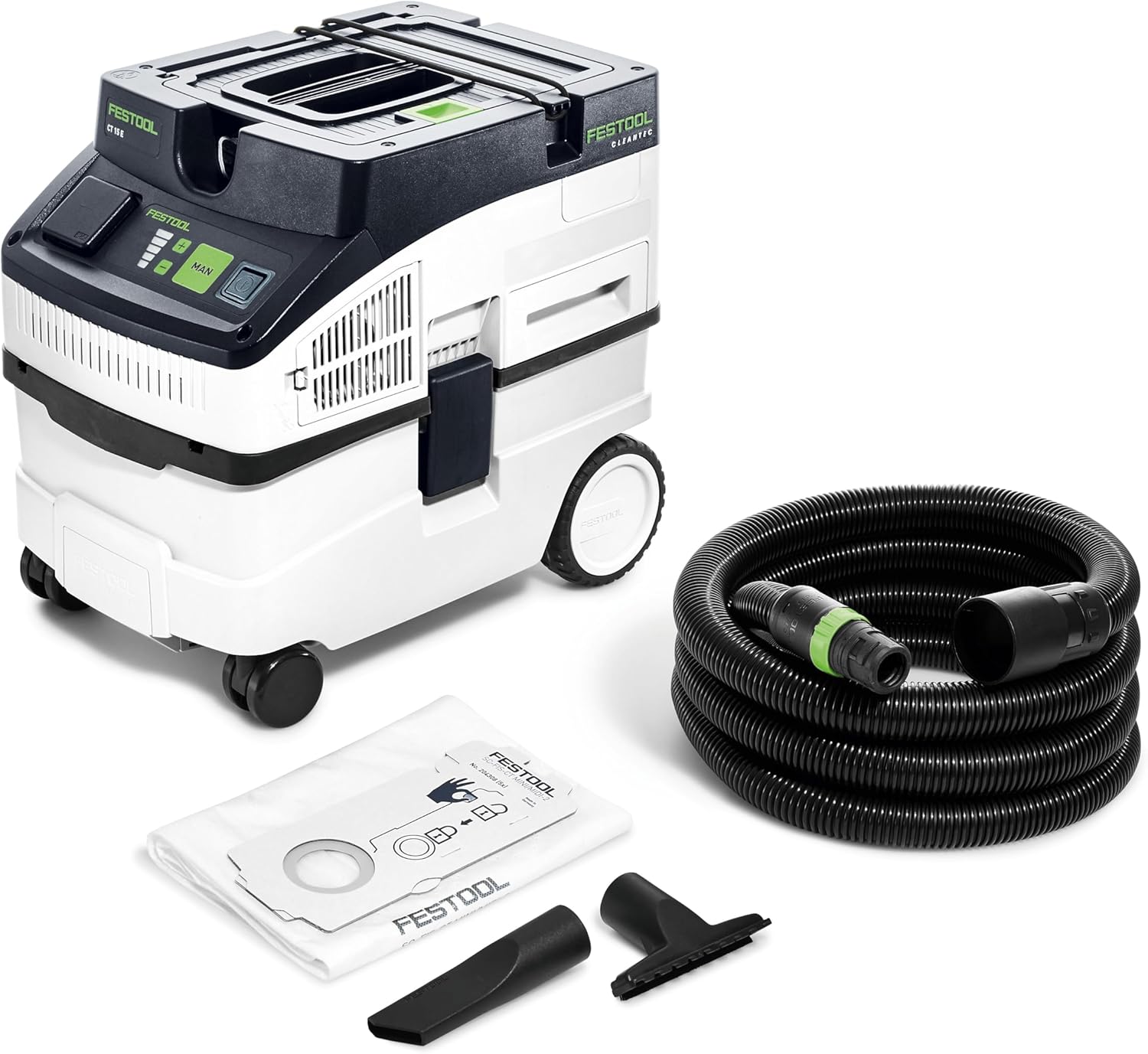
Dust collection only works when every connection is tight and correctly sized. A strong vacuum or dust collector cannot make up for a loose hose, the wrong adapter, or a clogged filter. This guide explains how hoses, adapters, separators, and filters fit together so you can assemble a reliable system in a home workshop.
How Sizing and Compatibility Work
Each connection consists of a male port on the tool or machine and the female end of the hose. Manufacturers sell hoses by nominal inside diameter, but the actual measurement varies from one product line to the next. A hose that claims a certain size can still feel loose or too snug on a port that uses a slightly different taper.
You will commonly run into three hose families. Shop vacuums and small dust collectors use flexible ribbed hoses with a round cuff or collar. Portable dust extractors use smaller hoses, and many of those use metric sizing even when the tool is sold in the United States. Larger dust collectors use bigger hoses for high airflow. Because these families mix, a stepped adapter or a purpose-built connector is often the easiest solution.
If you are planning a whole-shop setup, start with the basics in the dust collection and cleanup guide. It covers the difference between vacuums, extractors, and fixed dust collectors.
Measure Ports Before You Buy
The only way to be sure an adapter fits is to measure rather than guess. Hoses and ports look similar, but a small difference in size is enough to cause annoying leaks. A digital caliper gives the best reading, but a ruler with clear increments works for most home shop situations.
Measure the Tool Port
Find the port where the hose attaches on the tool, sander, saw, or stationary machine. If the port is a smooth cylinder, measure the outside diameter across the widest point. If the port has a tapered or flared lip, measure the area where the hose will actually seat.
Measure the Hose End
Measure the inside diameter of the hose itself. If the hose has a rigid cuff or collar, measure the inside of that collar as well. The cuff can change the effective size and determine which adapter sits flush.
Compare Your Numbers to Adapter Ranges
Stepped fittings are sold by the range of sizes they bridge, not by a single precise fit. If your port measurement falls near the middle of a step, that adapter is probably a safe choice. If it sits right at the edge of a step, look for a larger or smaller option instead.
Common labels you will see on hoses and fittings include 1.25, 1.5, 2.25, and 2.5 inches, with larger dust collector pipe often labeled at about 4 inches. Use these labels only as a starting point and verify the spec sheet against your own measurements.
Reference Table for Common Connections
The table below summarizes what to measure for each part of a small dust collection system.
| Component | Common Labels You May See | What to Measure | Fit Notes |
|---|---|---|---|
| Shop vacuum hose | 1.25, 1.5, 2.25, 2.5 inches | Inside diameter of the hose and the cuff | A cuff can make the connection feel tight even when the hose itself is loose. |
| Dust collector hose | Larger sizes, often around 4 inches | Inside diameter of the hose and outside diameter of the collector inlet | Flexible hose and rigid pipe can differ slightly; measure both. |
| Dust extractor hose | May use metric sizes | Inside diameter of the coupler and the tool port | Metric couplers often need a stepped adapter to mate with a shop vac. |
| Stepped adapter | Multiple steps on one fitting | Outside diameter of each step | Pick a fitting whose step range brackets your measured numbers. |
| Blast gate | Matches rigid pipe or hose size | Inside diameter of the gate bore | Match the gate to the pipe, then adapt the hose at the gate ends. |
| Separator inlet and outlet | Matches your hose sizes | Inside and outside diameters of both ports | Some separators have a smaller outlet than inlet; check both. |
Hoses: Standard, Anti-Static, and Crush-Resistant
Standard ribbed hose is the most common choice for shop vacuums and small dust collectors. The ribs keep the hose flexible, but the ridges can catch fine dust over time. Smooth-wall hose creates less airflow resistance, but it kinks more easily and usually costs more. For most home projects, standard ribbed hose is the practical default.
Anti-static hose contains a conductive element that dissipates static charge as air moves through it. Static buildup is common when moving fine dust through a plastic hose, and it can cause dust to cling to the walls and occasionally deliver a small shock. Manufacturers often recommend an anti-static hose for dust extractors and for sanding work that produces very fine particles. Check the manual for the extractor or dust collector and follow its grounding instructions.
If a hose runs across the floor in a busy workshop, look for a crush-resistant or abrasion-resistant version. Instead of a thin spiral, these hoses have thicker walls and a smoother interior, and they hold their shape when stepped on. The difference matters most on the hose that moves with the tool rather than on a fixed line.
For handheld power tools that connect to an extractor, the dust extractors for power tools guide explains which hose features and coupler styles help keep the airflow strong.
Adapters and Stepped Fittings
Adapters are the bridge pieces that connect different hose and port sizes. The basic stepped fitting is a tapered piece of rubber, vinyl, or plastic with several concentric rings. You trim the rings or simply push the larger hose over the outer step and the smaller port into the inner step. Because the steps get larger toward the base, one adapter can cover multiple sizes.
Before connecting or disconnecting anything, turn off the machine and unplug it or remove the battery. Then, if you need to trim a rubber adapter with a knife, mark the step that matches your hose and cut carefully. Avoid forcing a large hose over a step that is much too small; the forced fit can restrict airflow and stress the connection. If the adapter has to stretch significantly, choose a different step or a larger adapter.
Rigid reducers work differently. They are short plastic or metal sleeves with a smaller circular opening on one end and a larger opening on the other. They are common when a small extractor hose meets a large stationary tool port. Some fittings also have a barb that grips the inside of a hose plus a locking collar that snaps into the tool port.
For a complete list of these parts, see the dust collection accessories index.
Cyclone and Bucket-Top Separators
A separator sits between the tool hose and the vacuum or dust collector inlet. It spins the incoming air, forcing heavier chips and dust to drop into a container while the lighter air continues toward the filter. The most familiar home-shop style is the bucket-top separator, which fits onto a standard bucket or utility container with a sealed lid. A true cyclone uses a tapered cone and is generally better at removing very fine dust before it reaches the filter.
The main benefit is filter protection. Keeping large debris out of the vacuum bin reduces how often the filter clogs and keeps suction from fading during a project. A separator also makes emptying easier because you dump the container instead of wrestling with a dirty filter.
For best results, match the separator ports to the hose sizes on both the tool side and the vacuum side. A separator with a very small inlet compared to the hose can slow airflow noticeably. Check that the lid seal is airtight; a leaky bucket lid defeats the purpose. Empty the container before it fills completely so the separator continues to work correctly.
Blast Gates for Small Systems
If a dust collector serves several tools through a network of pipes, a blast gate lets you close the branches that are not in use. When every branch stays open, the airflow spreads out and each tool receives less suction. Closing the unused branches sends the full airflow to the active tool.
For a one-hose, one-tool setup, a blast gate is usually unnecessary. For a small system with two or three tool drops, a gate on each branch keeps the airflow predictable. Place the gate as close to the main trunk as practical so the dead branch does not hold dust.
The gate body should match the diameter of the rigid pipe or hose in that run, and the connections on either side can be adapted to flexible hoses. Choose a gate that closes fully and slides easily. A gate that leaves a gap when closed wastes airflow and lets dust settle in the unused branch.
Filter Bags and Cartridges
Dust collectors and many vacuums use either a filter bag or a pleated cartridge. A filter bag is a large fabric or felt bag that provides plenty of surface area for low pressure drop. A pleated cartridge packs even more surface area into a compact shape and often captures finer dust. Some machines accept both styles, but the mounting ring and collar must match exactly.
The filter is what protects the motor and cleans the air you breathe, so keep it in good condition. A clogged filter is the most common reason a dust collector slowly loses suction. Watch for a noticeable drop in pickup at the hose end, and clean or replace the filter according to the manufacturer’s instructions. A separator reduces the load, but it does not eliminate the need for filter care.
Turn off the machine, unplug it or remove the battery, and use respiratory protection such as a well-fitting dust mask or respirator before handling a filter. Clean the filter outdoors or in a well-ventilated area, and inspect the gasket or seal each time you reinstall it. A filter that leaks around the edge lets dust bypass the cleaning process entirely.
Common Mismatches and How to Avoid Them
Most dust collection problems come from a few repeated mistakes. Here is how to spot them before you buy:
- Assuming a label matches the actual port. Two hoses with the same nominal size can have different tolerances. Measure the port and the hose end, and compare both to the spec sheet.
- Mixing metric couplers with imperial hoses. Dust extractor couplers are often metric, while shop vac hoses are sold in inches. A stepped adapter or a replacement coupler solves the mismatch.
- The wrong adapter gender. Adapters have a male side and a female side. Check whether you need to slip over a port or accept a hose end.
- A blast gate the wrong size. Buy the gate to match the rigid pipe, then use short adapters on the hose connections at each side.
- Separator ports that do not match the hoses. Compare the separator inlet and outlet to your existing hose ends before ordering, not just the advertised size.
- A filter with the wrong collar. The mounting ring on the machine must match the filter collar; measure the ring diameter and compare it to the filter spec.
FAQ
How do I know which hose adapter to buy?
Measure the outside diameter of the tool port and the inside diameter of the hose end. Compare both numbers to the stated range of a stepped adapter, and verify the sizing on the manufacturer’s spec sheet before you order.
Should I use an anti-static hose with a shop vacuum?
It is not always required, but it is the safer choice when you move very fine dust or when the extractor manual calls for it. Follow the grounding instructions that come with the machine.
Will a cyclone or bucket-top separator fit any dust collector or vacuum?
Most separators install between the hose and the collector inlet, but you must match or adapt the port sizes on both ends. Some bucket lids are made for a specific container, so check the lid seal and port dimensions before buying.
How can I tell when the filter needs cleaning?
When the airflow drops or the suction at the hose end weakens noticeably, the filter is likely clogged. Follow the manufacturer’s instructions for cleaning and replacement intervals.
The pattern is simple: measure first, adapt thoughtfully, and keep the airflow path tight. With well-matched hoses, a separator, and a clean filter in place, your dust collection system will do its job reliably.