Every serious toolbox needs at least one wrench, and most jobs go faster when you own a set that covers both SAE and metric sizes. This guide explains how the main wrench types differ, which ends and features actually matter, and how to use them safely so you do not round off a fastener or hurt yourself.
Main Wrench Types and How They Differ
All wrenches do the same basic job: they grip a fastener and let you turn it. Beyond that, each type trades off grip, speed, access and adjustability differently. For a deeper look at choosing and organizing these tools, the main wrenches guide is a good next stop.
Combination Wrenches
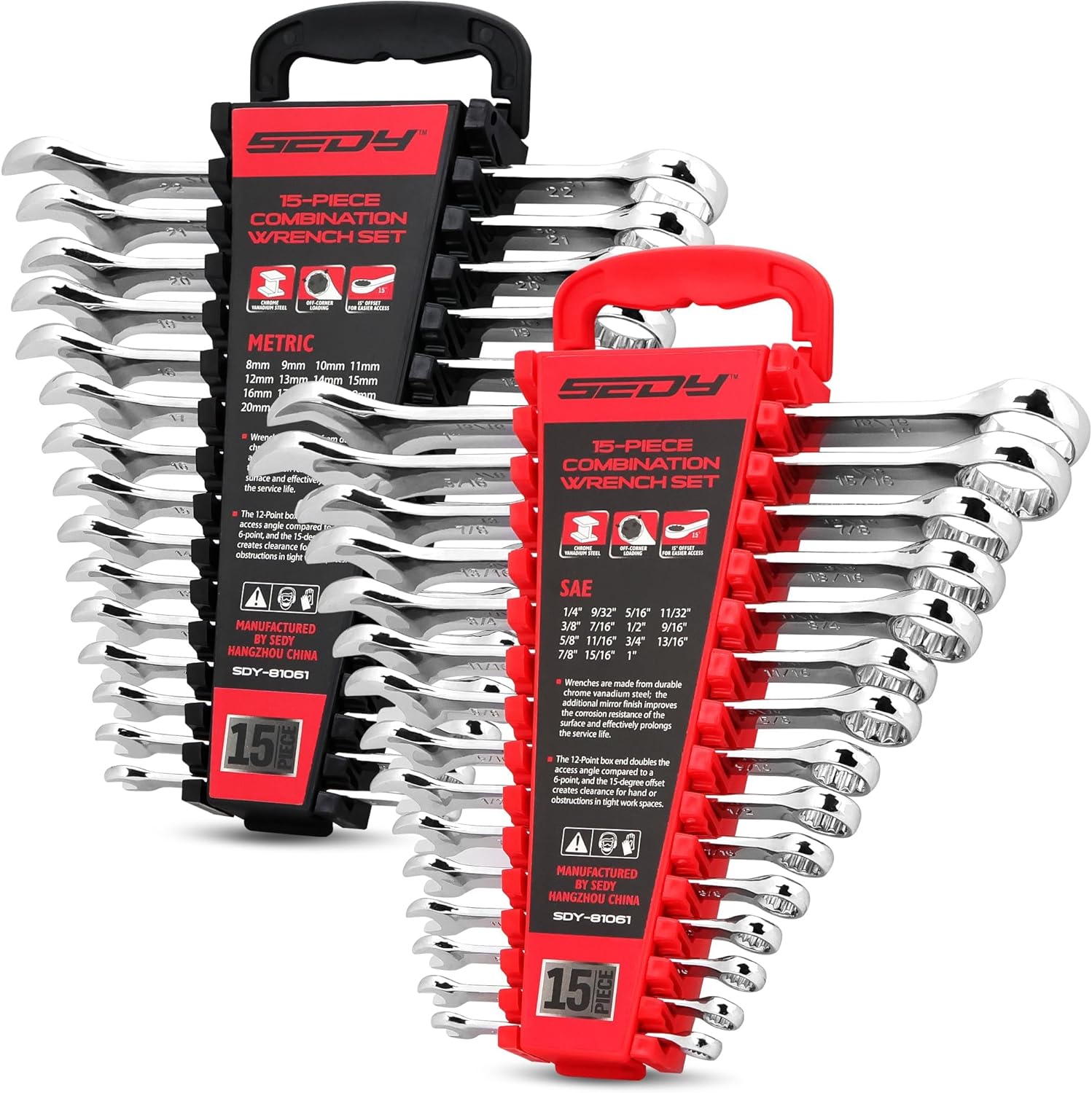
Combination wrenches have an open end on one side and a box end on the other. The open end slides over a nut from the side, which makes it useful in tight spots where you cannot fit the wrench over the top. The box end wraps completely around the fastener and is stronger, so you use it for breaking loose and final tightening. Most sets are built around this style, and a combination wrench set is the sensible starting point for a home toolbox.
Adjustable Wrenches
An adjustable wrench has one movable jaw, so a single tool fits many different fastener sizes. It is handy when you do not know what size a bolt is or when you need to carry just one wrench. The tradeoff is that the jaws can slip, especially if you use the wrench the wrong way around. Seat the jaws fully on the flats and position the wrench so the fixed jaw takes most of the load as you pull. Keep it snug but not jammed tight. For heavy work, a properly sized combination wrench is the better choice.
Ratcheting Wrenches
Ratcheting wrenches look like combination wrenches, but the box end contains a gear that lets you pull in one direction, release, and pull again without lifting the wrench off the fastener. That makes them much faster for repeated turns. Some models have a flex head so you can angle the box end into awkward spaces, and most include a reversing lever or let you flip the wrench to change direction. They are excellent additions to a set, but the moving parts make the box end bulkier than a plain one, so keep a standard combination wrench nearby for the tightest areas.
Flare-Nut Wrenches
Flare-nut wrenches, sometimes called line wrenches, are built for brake and fuel lines. They have a box end with a slot cut out of one side, which lets the wrench slip over the line while still gripping the nut on almost all sides. A regular open end can squeeze a soft flare nut and round off the corners; a flare-nut wrench spreads the grip and is far less likely to damage a fitting. Use them gently, seat the wrench fully, and follow the vehicle or equipment manufacturer’s service instructions, especially when working around fuel and brake fluid.
Pipe Wrenches
A pipe wrench is a heavy adjustable wrench with toothed jaws and little give in the grip. The teeth bite into round steel pipe, which is how you get enough traction to turn it. Pipe wrenches are for pipe and fittings only, not for bolts, and the jaws will mar chrome, brass and finished surfaces. The wrench is also directional: if you flip it over, it will slip or pull loose instead of turning the pipe. Keep the pivot nut snug so the jaws do not rattle, and set the hook jaw so the wrench grips the work about halfway along the jaw length.
| Type | Best For | Main Limitation |
|---|---|---|
| Combination wrench | General fasteners on bolts and nuts | One fastener size per wrench |
| Adjustable wrench | Mixed sizes when you carry few tools | Jaw can slip under heavy load |
| Ratcheting wrench | Repeated turning in open spaces | Bulkier box end |
| Flare-nut wrench | Brake and fuel fittings | Not as strong as a solid box end |
| Pipe wrench | Round steel pipe and fittings | Marks surfaces, grips in one direction |
SAE vs Metric and Why You Likely Need Both
Fastener sizes come in two families. SAE sizes are inch-based, using fractions like 1/2 inch and 9/16 inch. Metric sizes are measured in millimeters, like 10mm and 13mm. Cars built by American and European brands have used metric fasteners for decades, while some trucks, older equipment and many household appliances still use SAE. The result is that most homes and garages genuinely need both sets.
A typical starter set covers a range of common sizes in each system. In metric, a set often covers sizes from around 8mm up to 19mm. In SAE, a common range runs from 1/4 inch up to 3/4 inch. The exact sizes vary by set, so look at the spec sheet and compare it with the fasteners you actually run into on your own projects.
Do not assume you can skip one system because your car is a certain brand. Fuel line fittings, suspension bolts, appliance connections and even some furniture all skip around. A combination set that includes both SAE and metric sizes is the fastest way to cover your bases.
6-Point vs 12-Point Box Ends
The box end of a wrench can have six points or twelve points on the inside. A 6-point box end has six flat contact surfaces and matches the six flats of a common hex nut almost perfectly. This gives the best grip and is the hardest to round off, which is why many heavy-duty sets use 6-point ends exclusively.
A 12-point box end has the same outside shape, but the internal points are arranged so the wrench can engage the fastener in more positions. In theory, you can slip it onto a bolt in roughly 30-degree steps instead of 60-degree steps, which helps in narrow spaces. The tradeoff is that the wrench touches the fastener over less contact area, and it is easier to round a partially worn nut. For general use, a 6-point end is the safer default; keep 12-point wrenches in your set when you regularly work around obstructions.
Many wrenches also have an angled offset in the beam, often with the open end angled to give the bolt head more clearance. This offset is normal, and it affects which way you flip the wrench for a given clearance.
Features That Actually Matter
Beyond the basic shape, a few features separate a useful wrench from a frustrating one.
- Overall length. Longer wrenches give more leverage but are bulkier in tight spaces. Look for a set with a comfortable progression of lengths; the spec sheet tells you each wrench’s length so you can compare.
- Jaw grip. Some open ends have small notches or a curved profile that help the wrench hold the flats of a nut instead of slipping over the corners. These help, but the correct size still matters more.
- Markings. Stamped or laser-marked sizes stay readable for years, while painted marks can wear off quickly.
- Finish. Chrome and satin finishes both work; satin feels less slippery in oily hands, and chrome wipes clean more easily. Pick either, then focus on fit.
- Stubby versions. A short stubby wrench can reach fasteners in confined spaces where a full-length wrench will not fit. Add stubbies after you own a standard set, not instead of one.
How to Use Wrenches Safely
Pulling is safer than pushing. When you pull, the wrench tends to stay seated on the fastener, and if it slips, your hand usually moves away from the work rather than into it. Push only when there is no other option, and then use the heel of your hand with your palm open so you do not smash your knuckles. Do not use a cheater bar on a standard wrench. Sliding a pipe over the handle multiplies the force, but it also multiplies the risk of bending the wrench, rounding the fastener or snapping the handle. If a nut will not move, use the correct size, apply penetrating oil where it is safe, or get a longer wrench designed for the job.
Fit matters as much as technique. A loose adjustable wrench or a too-large combination wrench will round off a bolt head in no time. Seat the wrench fully on the flats before applying force, keep the wrench level with the fastener, and inspect the fastener for rust or damage first. Wear safety glasses when working under a vehicle or when a fastener might pop loose under tension, and keep your fingers away from pinch points. Read and follow the manufacturer’s instructions that came with your wrench set.
Also, do not use a wrench as a hammer or pry bar. A wrench is made for turning, not striking. If rust is the problem, use a penetrating oil and let it soak according to the product instructions.
Common Buying Mistakes
- Buying only SAE or only metric. You will almost certainly need both, so a dual set is a better first purchase.
- Chasing the cheapest set. A flexible, badly fitting wrench will slip and cause damage; a modest mid-range set is a better value than a bargain bin set.
- Choosing 12-point everything. Twelve-point wrenches seem versatile, but they have more slip risk. A quality 6-point set plus a few 12-point specialty wrenches is a balanced approach.
- Ignoring the box end. The open end is handy, but the box end is the one that takes the real load.
- Buying only an adjustable wrench. It is fine for odd jobs, but it is no match for a full combination set when you face a stubborn bolt.
- Skipping flare-nut wrenches for vehicle work. The first time a brake line fitting is stuck, you will be glad you have one.
Care, Cleaning and Upkeep
Wrenches last for decades if you treat them well. Wipe them down after dirty work, and dry them completely before putting them away. A light coat of oil on the steel parts helps prevent rust, especially in humid garages. If a ratcheting wrench starts to feel sticky, clean the mechanism with a mild solvent, dry it, then lubricate it lightly. Check the manufacturer’s instructions first, since some mechanisms need specific care.
Store wrenches in a roll, a drawer organizer or on a wall rail so you can find the right size quickly. Do not toss them loose into a bin where they knock against each other and chip.
Keep chemicals off the wrench as much as possible. Long soaks in solvent can wash away internal grease in ratcheting ends, and wet handles become slippery in your hands.
Top Picks to Compare
If you would rather start from a short list, these are popular options on Amazon for this search. Check each listing’s details, size and current price before you buy.


FAQ
Do I need both SAE and metric wrenches?
For most people, yes. Cars, appliances and household fixtures mix systems, and a dual set is the simplest way to be ready for whatever a project throws at you.
What is a combination wrench?
It is a single wrench with an open end on one side and a box end on the other. You get the side access of an open end and the strength of a closed end in one tool.
Which end should I use, open or box?
Use the box end to break fasteners loose and for final tightening. Use the open end when you need to slip the wrench in from the side, but apply less force with it.
Can I use a pipe wrench on a bolt?
It might fit, but it is a bad idea. Pipe wrenches leave teeth marks, grip in only one direction, and are too clumsy for exact work. Use the correct combination wrench instead.
Start with a quality combination set that covers both SAE and metric, add a ratcheting wrench or two and a flare-nut wrench for vehicle work, and keep a pipe wrench around for plumbing. With a snug fit and good habits, your wrenches will handle projects for years. If you are building out your garage tool kit, browse the hand tools section for more guidance on what belongs in a well-rounded collection.