
 By Caleb Morgan
Updated November 2026
Choosing woodworking circular saw blades comes down to four things: diameter and arbor size so the blade fits your saw, tooth count for the cut quality you need, kerf width for how much material you can spare, and tooth geometry for the wood you cut most. The five options below cover framing-speed cuts, general purpose work and fine finish cuts, with notes on who each one suits.
Our top picks at a glance
- 1
 TOP CHOICEBest overallRevvstark 5-1/2" 24T&48T Circular Saw BladeView on Amazon
- 2
 TOP CHOICEBest for multi-pack valueHOJR 10-Pack 6-1/2 Inch 24-Tooth Woodworking Circular Saw BladeView on Amazon
- 3
 TOP CHOICEBest for changing cut types7-1/4 Circular Saw Blade Fine Finish for Woodworking, 3-PackView on Amazon
- 4
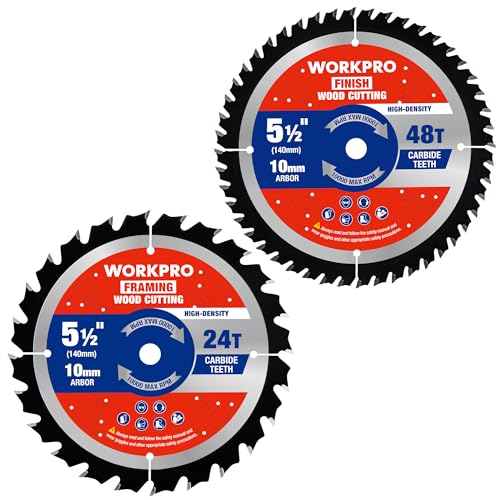 Best for plywood and thin stockWORKPRO 5-1/2" Circular Saw Blades, 2-PackView on Amazon
- 5
 Best for small or angle-grinder toolsONEGOTOOL 4-1/2" Circular Saw Blades for Wood, 3-PackView on Amazon
Our Top Picks
| Product | Best for | Key feature |
|---|---|---|
| Revvstark 5-1/2″ 24T&48T | Mixed wood cutting | Carbide tipped TCT teeth |
| HOJR 10-Pack 6-1/2″ 24T | Framing and rough cuts | Non-stick coating, 10 blades |
| 7-1/4″ Fine Finish 3-Pack | Finish work | 24T, 40T and 60T set |
| WORKPRO 5-1/2″ Thin Kerf Set | Plywood and hardwood | Thin kerf ATB teeth |
| ONEGOTOOL 4-1/2″ 3-Pack | Small saws and grinders | 7/8″ arbor fit |
Revvstark 5-1/2″ 24T&48T Circular Saw Blade
Revvstark 5-1/2"(10mm Arbor) Circular Saw Blade 24T&48T for Cutting Wood | Carbide Tipped Teeth, Heavy Duty TCT Saw Blades for Cutting Various Wood, Plastic and Composite Materials
Best for: Mixed wood cutting on smaller saws
This suits hobbyists who move between lumber, plywood and occasional plastic or composite stock and want one blade that handles several materials. For a deeper look, 6 Best Circular Saw Dado Blades for Woodworking (2026) covers this in detail.
Pros
- Carbide tipped teeth hold an edge across mixed materials.
- The 24T and 48T tooth counts cover both rough and cleaner cuts.
Cons
- The 10mm arbor needs a matching adapter on most saws.
HOJR 10-Pack 6-1/2 Inch 24-Tooth Woodworking Circular Saw Blade
HOJR 10-Pack 6-1/2 Inch 24-Tooth 5/8" Arbor Woodworking Circular Saw Blade,Framing/General Purpose Wood Cutting Saw Blade,with Non-Stick Coating – TF, 6-1/2" 24T 5/8"
Best for: Framing and rough cuts
This is aimed at framers and job-site users who go through blades quickly and want a stack of replacements on hand.
Pros
- Ten blades per pack keeps a spare ready for every job.
- Non-stick coating helps reduce resin buildup on softwood.
Cons
- The 24-tooth geometry leaves a rougher edge than finish blades.
7-1/4 Circular Saw Blade Fine Finish for Woodworking, 3-Pack
7-1/4 Circular Saw Blade Fine Finish for Woodworking, 24T&40T&60T, 3PACK | 24T Framing & 40T General & 60T Fine Finish TCT ATB Carbide Saw Blades, 5/8" Arbor for Wood, Plastic, PVC, Acrylic Cutting
Best for: Changing cut types
Woodworkers who switch between rip, crosscut and finish work will appreciate having three tooth counts in one package.
Pros
- The 24T, 40T and 60T set covers framing through fine finish.
- The 5/8″ arbor fits most standard 7-1/4″ saws.
Cons
- The 60T blade cuts slower and runs hot in thick hardwood.
WORKPRO 5-1/2″ Circular Saw Blades, 2-Pack
WORKPRO 5-1/2" Circular Saw Blades, 24T/48T Framing & Finish Blade Set | Thin Kerf Carbide Tipped ATB Teeth for Plywood, Hardwood & Softwood Cutting, DIY Woodworking Projects, 2 Pack
Best for: Plywood and thin stock
Users cutting sheet goods on lighter saws often want a thin kerf blade to reduce motor strain and material waste.
Pros
- Thin kerf body removes less material per cut.
- The 24T and 48T pair covers both framing and finish cuts.
Cons
- Thin kerf blades can deflect in thick hardwood if the feed rate is pushed.
ONEGOTOOL 4-1/2″ Circular Saw Blades for Wood, 3-Pack
ONEGOTOOL 4-1/2 inch Circular Saw Blades for Wood Cutting Angle Grinder Blades for Woodworking, PVC, Rubber, Tire Cutting Discs 7/8" Arbor – 3 Pack
Best for: Small saws and angle grinders
This suits people who need a small-diameter wood blade for compact tools rather than a full-size circular saw.
Pros
- The 7/8″ arbor fits many angle grinder setups.
- Three blades per pack gives a useful backup supply.
Cons
- The 4-1/2″ diameter limits cut depth on thick stock.
Buying Guide
Diameter and arbor size
Match the blade diameter to your saw’s maximum rating and confirm the arbor hole. Most full-size saws use 7-1/4″ blades with a 5/8″ arbor, while 6-1/2″ and 5-1/2″ blades are common on compact saws. For a deeper look, see Circular Saw Blade Size: How to Pick the Right Diameter (2026) and Circular Saw Blade Dimensions: Diameter, Arbor and Kerf Explained.
Tooth count
Fewer teeth (24T) remove material quickly for framing and rough cuts. Higher counts (40T to 60T) leave a cleaner edge for finish work but cut slower. Saw Blades: Tooth Count, Kerf and Grind for Circular, Miter and Table Saws explains the tradeoffs in more detail.
FAQ
What tooth count should I use for fine woodworking cuts?
Blades with 60 or more teeth, such as the 60T option in the 3-pack, produce the smoothest edges on hardwood and plywood. Higher tooth counts cut more slowly but leave less tear-out, which makes them a better choice for visible joints and finished pieces.
Is a 24-tooth blade good for framing?
A 24-tooth blade is generally used for framing and rough cuts because it removes material quickly and clears sawdust well. Expect a rougher finish than you would get from a finer blade, so it is best for lumber that will be covered or trimmed later.
What does arbor size mean and why does it matter?
The arbor is the center hole that mounts the blade onto your saw’s spindle. The hole must match your saw exactly, so check your saw’s manual or the current blade before buying, since a mismatch means the blade will not fit safely.
Can these blades cut materials other than wood?
Some of these carbide-tipped blades are designed to handle plastics, PVC, acrylic and composites in addition to wood. Cutting metal, masonry or tire rubber requires a blade specifically made for those materials, so read the product description carefully before using a blade outside its intended range.
What is kerf and how does it affect my cuts?
Kerf is the width of the slot a blade removes as it cuts. Thin-kerf blades remove less material and put less strain on smaller saws, while standard-kerf blades are sturdier and can be better for thick or dense stock.
How often should I replace my circular saw blade?
Replace or resharpen a blade when it begins to burn the wood, leaves rough or uneven edges, or requires noticeably more force to push through the material. Regular cleaning of pitch and resin buildup also helps a blade cut cleanly for longer.
Conclusion
If you want one dependable blade for a mix of general work, the Revvstark 5-1/2 inch option is a practical starting point, and the HOJR multi-pack suits anyone who goes through blades quickly or needs spares on hand. For framing and rough cutting, favor the 24-tooth options, while the 3-pack with its 60-tooth fine finish blade is the better pick for cabinetry, furniture and visible trim.
Shoppers working with smaller handheld tools or cutting non-wood materials such as plastic, PVC or rubber should consider the ONEGOTOOL 4-1/2 inch set, and anyone matching a specific saw should double-check arbor size before ordering. Match the blade to your saw, your material and the finish you need, and the right choice from this list will be clear.
Related reading
- Ryobi Circular Saw Blade Installation: A Step-by-Step Guide
- How to Sharpen a Saw Blade Circular (2026): DIY Sharpening vs Sending It Out
About Caleb Morgan
Caleb Morgan is part of our editorial team and reviews and edits our power tools guides, checking product details against manufacturer specifications and owner feedback.



