Some links on this page are affiliate links. If you buy through them, we may earn a commission at no extra cost to you. As an Amazon Associate I earn from qualifying purchases. Learn more ›
Best Saw Blades
We compared saw blade listings by specs and features across circular, reciprocating, jigsaw and oscillating types. Check each listing for current details.
This post contains Amazon affiliate links. As an Amazon Associate I earn from qualifying purchases, at no extra cost to you.
Searching for the best saw blades usually starts with matching a blade to your saw and the material you plan to cut. This roundup covers circular, reciprocating, jigsaw and oscillating blades, along with multi-piece sets, so you can compare what each listing describes.
The picks were chosen by comparing listing specs and features, not by hands-on testing, and we have not used these blades ourselves. Check each listing for current price, availability and full details before you buy.
The EZARC 15-inch Arc Edge reciprocating saw blade set is a three-pack of aggressive 6 TPI Japanese-tooth blades built for cutting green wood, dry wood, and firewood up to 300mm in diameter. It suits homeowners and landscapers who need a fast, controlled cut on larger branches and limbs, though it is not compatible with Ryobi saws.
Pros & Cons
Pros
Cuts quickly through larger branches and limbs up to 300mm in diameter
Arc edge design produces smooth, controlled cuts with less binding
Wide compatibility with most major reciprocating saw brands
Three blades in one set offer good value for regular yard maintenance
Cons
Not compatible with Ryobi reciprocating saws
Works best on wood, with the 6 TPI pitch being coarse and less suited to fine or finished cuts
Aggressive coarse teeth can leave a rougher surface finish than fine-tooth blades
Detailed Review
The EZARC Arc Edge Reciprocating Saw Blades are a three-pack of 15-inch Japanese-tooth blades designed for pruning, tree trimming, and firewood cutting. They are aimed at homeowners, landscapers, and outdoor enthusiasts who regularly work with thick branches and limbs and want more reach than a standard pruning blade provides.
The standout feature is the combination of a 370mm blade length with a 320mm working length and a 6 TPI aggressive tooth profile. The triple-ground offset teeth provide three cutting angles that reduce friction, which helps the blade move through green and dry wood with a smoother, more controlled motion. Fleam-ground teeth and deep gullets clear chips efficiently during longer cuts.
The alloy steel construction feels sturdy, and the arc edge gives the blade a practical shape for reaching into branch clusters. The universal shank fits most common reciprocating saw brands, although Ryobi owners will need a different option. The blades are lightweight at roughly 0.23 kg each, making them easy to handle during extended trimming sessions.
The main drawback is the coarse 6 TPI pitch, which is built for speed rather than finish quality. Cuts will be rougher than those made with a fine-tooth blade, so these are not the right choice for woodworking or precise cuts. Ryobi incompatibility also limits the audience for this set.
For anyone who needs to clear larger branches or prepare firewood with a reciprocating saw, the EZARC three-pack offers strong cutting performance and good value. It is best suited to rough-cut pruning and yard work rather than finish carpentry.
The Bionso 55-piece oscillating saw blade kit bundles a wide range of blade shapes and tooth patterns for cutting wood, plastic, and metal with most quick-release multitools. It suits DIYers and tradespeople who want variety on a budget, though blade longevity under heavy professional use is less proven.
Pros & Cons
Pros
Exceptional value, with 55 blades costing less than comparable single-brand kits
Broad compatibility with major oscillating multitool brands reduces the need for separate blade sets
Organized storage case keeps blades sorted and easy to locate on the job site
Cons
Individual blades may not match the durability of premium brand-name blades under heavy, continuous use
Adapter compatibility varies by tool model, so buyers should verify the correct adapter before purchase
Blade count is high, but many specialty pieces may go unused by casual homeowners
Detailed Review
The Bionso 55-piece oscillating saw blade kit is a versatile accessory set built for anyone who owns an oscillating multitool and needs blades for wood, plastic, and metal. It is aimed at DIY homeowners, remodelers, and hobbyists who want a broad selection without paying premium prices for individual blades.
Standout features include a wide range of tooth sizes and blade shapes, which allow flush cuts, plunge cuts, and detail work in tight spaces. The universal interface is designed to fit more than 95% of oscillating tools, with adapter options provided for different brands such as DeWalt, Ryobi, Milwaukee, and Makita.
The blades are made from high carbon steel and bimetallic alloy, which is intended to resist wear and hold an edge across repeated cuts. In typical use, they cut cleanly through softwood, drywall-adjacent trim, and thin metal, though aggressive cutting in hardened materials will wear them faster.
The main drawback is that consistency across such a large assortment can vary, and some specialty blades will see limited use outside of niche projects. Buyers should also confirm adapter compatibility for their specific tool before ordering to avoid fit issues.
Overall, this kit offers strong value for DIYers and general contractors who want variety and flexibility on a budget. Professionals who depend on premium blade life for daily heavy cutting may still prefer dedicated brand-name blades for critical jobs.
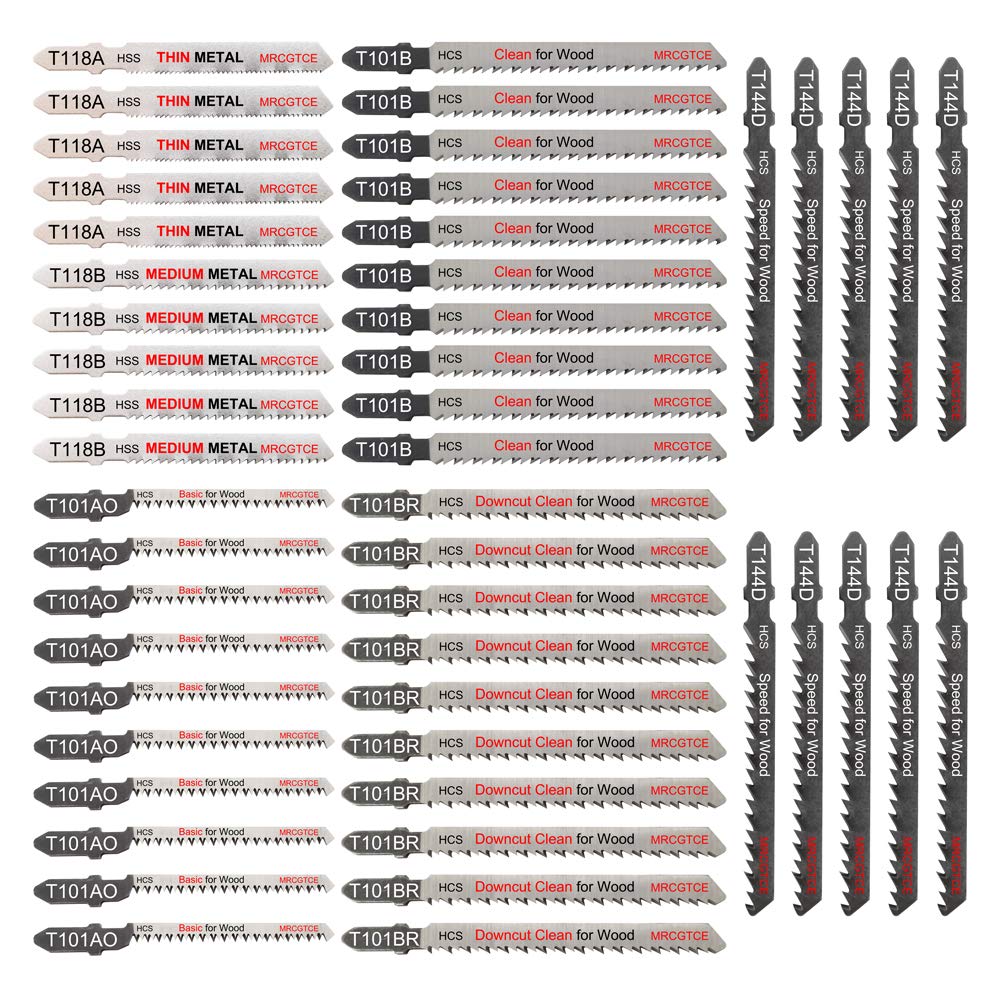
This 50-piece assorted T-shank jigsaw blade kit covers wood, plastic, and metal with six blade types in a storage case that keeps them organized. It suits DIYers and contractors who need one set for varied cutting jobs, though the blades are best for general-purpose work rather than heavy production use.
Pros & Cons
Pros
Excellent value, with 50 blades across six types in a single purchase
Versatile for wood, laminates, plastics, OSB, and thin to medium-thin metals
Storage case keeps blades organized and protected between uses
Strong overall customer rating based on a large number of buyer reviews
Cons
Only 5 blades each for the metal types, so heavy metal fabrication may require replacements sooner
Blade thickness and tooth count limit use on thick metals above 1/4 inch and very precise hardwood work
Aimed at general-purpose cutting, so professional production users may prefer premium brand blades
Detailed Review
This MRCGTCE 50-piece kit is a practical assortment of T-shank jigsaw blades for homeowners, DIY enthusiasts, and contractors who need a single set for wood, plastic, and metal. It includes six blade styles, so it covers everything from fine scroll work to fast rough cuts.
The standout feature is the range of tooth counts. The 21 TPI blades give smooth metal and scroll cuts, the 10 TPI blades deliver straight, clean cuts in wood and plastic, and the 6 TPI blades remove material quickly in thick lumber. The downcut reverse-tooth blades help keep the top surface of laminates and plywood splinter free.
Build quality is solid for the price, with high carbon and high speed steel construction that holds an edge through typical home and light trade use. The included storage case is a real convenience, keeping the blades sorted and reducing the chance of losing or damaging them in a toolbox.
The main drawback is the balance of quantities. Each blade type includes only five or ten pieces, so anyone running frequent metal cuts or long production runs will go through the metal blades faster than the wood blades. The metal blades are also limited to moderate thicknesses, so they are not suited to heavy plate.
Overall, this is a strong value for anyone who wants a versatile starter or everyday jigsaw blade collection. Buyers who need professional-grade performance for heavy metal or daily production work should consider premium blades, but for most home and general contractor projects this set delivers reliable results and excellent organization.
The DEWALT DW4898 is a 10-piece bi-metal reciprocating saw blade set with a Tough Case, covering general wood cutting and metal cutting in 6 to 9 inch lengths. Its reinforced teeth and 6-degree aggressive angle make it a practical choice for DIY users and tradespeople who want one kit for common demolition and remodeling tasks.
Pros & Cons
Pros
Excellent value for a complete wood and metal blade assortment in one set
Durable Tough Case keeps blades protected and organized on job sites
Reinforced teeth hold up well when cutting through nails and debris
Cons
Bi-metal blades wear faster than carbide-tipped options when cutting hardened steel or thick stainless steel
Only four blade types are included, so specialty materials such as tile, fiber cement, or masonry will require additional blades
Blades are designed for DEWALT reciprocating saws and may not fit every competing brand without an adapter
Detailed Review
The DEWALT DW4898 is a 10-piece bi-metal reciprocating saw blade set designed for everyday wood and metal cutting. It suits homeowners, remodelers, and tradespeople who want a versatile kit without buying blades individually.
The set includes four 6-inch 6 TPI wood blades, four 6-inch 18 TPI metal blades, one 8-inch 14 TPI metal blade, and one 9-inch 6 TPI wood blade. The reinforced teeth and 6-degree angle help the blades cut quickly and stand up to nails and other obstacles common in demolition work.
Bi-metal construction gives these blades a good balance of flexibility and edge life, which matters when a blade meets unexpected resistance. The included Tough Case is sturdy and keeps the blades organized, though it takes up noticeable space in a tool bag.
The main drawback is that bi-metal blades will not last as long as carbide-tipped blades when cutting very hard or thick metals. Buyers working with tile, masonry, or fiber cement will need to purchase specialty blades separately.
Overall, the DW4898 offers strong value for anyone who needs a reliable all-purpose blade set for wood and metal. It is a practical, well-rated starting kit for most DIY and light professional jobs.
The Xmnbl 14 Inch Metal Cutting Saw Blade is a 66-tooth, carbide-tipped TCG blade designed as a replacement for Evolution and other 14-inch low-RPM metal chop saws running at 1,600 RPM or less. It suits fabricators and maintenance workers who regularly cut mild steel plate, angle iron, and pipe and want a budget-friendly alternative to OEM blades.
Pros & Cons
Pros
Wide compatibility with many popular 14-inch low-RPM metal cutting saw models
Clean, precise cuts on mild steel, angle iron, and pipe according to the TCG tooth geometry
Carbide-tipped construction offers good durability for regular shop or job site use
Lower cost than many OEM replacement blades for the same saw platforms
Cons
Strictly limited to saws rated 1,600 RPM or less, so it must not be used on higher-speed saws
Listed compatible material includes stainless steel, but the blade is marketed mainly for mild and ferrous metals, so results on harder alloys may vary
Detailed Review
The Xmnbl 14 Inch Metal Cutting Saw Blade is a replacement blade built for 14-inch low-RPM metal chop saws, including Evolution S14CPS, S355CPS, and S380CPS models as well as Dewalt DW872, Milwaukee 6190-20, and Ridgid 614 units. It is aimed at fabricators, maintenance crews, and serious DIY metalworkers who need a dependable blade for mild steel.
The standout feature is the 66-tooth TCG trapezoidal geometry, which gives each tooth a small, flat cutting surface. In practice this translates to cleaner cut edges on angle iron, plate, and pipe, with less chatter than a generic blade when the saw is run within its rated speed.
The blade uses a carbide-tipped construction with a 1-inch arbor and a 6-inch maximum depth of cut. Build quality appears solid for the price, though the blade is a consumable and its lifespan will depend on the material, feed pressure, and cooling practices used on the job.
The main drawback is the strict 1,600 RPM ceiling, which rules it out for higher-speed saws. Its stainless steel compatibility listing also deserves caution, since the blade is positioned primarily for mild and ferrous metals. Buyers should confirm their saw's rated speed before ordering.
Overall, this blade offers strong value for anyone cutting mild steel on a compatible 14-inch chop saw. It delivers reliable, precise results at a lower price than many OEM options, and the responsive support policy adds reassurance for a purchase of this type.
This 12-piece bi-metal reciprocating saw blade set includes four blade types in 6, 8, and 9 inch lengths, covering nailed wood, thin metal, and medium-thick metal cutting in one kit. It suits DIY homeowners and light construction users who need versatile blades and a storage box at a budget-friendly price.
Pros & Cons
Pros
Strong value, with a wide range of blade lengths and tooth pitches in a single kit
Universal shank design fits most reciprocating saw brands with no extra tools
Storage case keeps blades organized and protected
Cons
Bi-metal blades are not carbide-tipped, so they will wear faster on very hard or abrasive materials
Brand is less established than major tool makers, so long-term durability should be verified by your own use
Specifications list the material as high carbon steel while the description says bi-metal, so confirm the construction before purchase
Detailed Review
The LQOQA 12-Piece Bi-Metal Reciprocating Saw Blade Set is a versatile kit aimed at homeowners, DIY enthusiasts, and light construction users. It packs four blade types in 6, 8, and 9 inch lengths into a single storage box, so you can move from demolition work to metal trimming without buying separate blades.
The standout feature is the tooth pitch range. The 6 TPI wood blades are built for fast feeding through hardwood and nailed lumber, while the 18 TPI and 14 TPI metal blades are designed for thin sheet and steel pipe. The 9 inch blade adds reach for deeper cuts in larger timber.
Build quality centers on high-carbon steel with heat treatment for hardness and wear resistance. The universal shank fits most mainstream reciprocating saws, so there is no adapter to hunt down. The included case keeps the blades sorted and protected in a job box or truck bed.
The main drawback is the blade construction. These are bi-metal blades rather than carbide-tipped, so they will not last as long on abrasive or very hard materials. The listing also mixes the terms bi-metal and high carbon steel, so buyers should check the actual product before relying on it for heavy professional use.
At this price, the set offers strong value for occasional and moderate use. It is a sensible choice for homeowners and DIYers who want broad coverage, while professionals cutting heavy metal daily should consider higher-end carbide-tipped blades.
The SEDY 88107 is a 3-pack of 15 inch arc edge Japanese-tooth reciprocating saw blades with 6 TPI, built from chrome vanadium steel for pruning and cutting green or wet wood. It suits homeowners and landscapers who need extended reach for trimming larger branches and limbs from a reciprocating saw.
Pros & Cons
Pros
Long 15 inch length reaches branches that standard pruning blades cannot
Fast, clean cuts through green and wet wood with efficient chip removal
Good value for a three-pack of specialty pruning blades
Cons
Long blade length requires careful control and can flex or wobble on very thin cuts
6 TPI is aggressive and better suited to rough cuts than fine finish work
Universal shank fit should be verified against your specific saw model, as some tools may need a clamp or adapter
Detailed Review
The SEDY 88107 is a three-pack of 15 inch reciprocating saw blades designed for tree trimming, pruning, and cutting green or wet wood. It is aimed at homeowners, gardeners, and landscapers who want to extend the reach of their reciprocating saw beyond what standard pruning blades allow.
The standout feature is the arc edge design combined with Japanese-style teeth. The triple-ground offset tooth pattern offers three cutting angles that reduce friction, while the deep gullets clear sawdust quickly, so the blade keeps moving through larger limbs without bogging down.
Build quality centers on chrome vanadium steel, which gives the blades good toughness and wear resistance. The body is designed to resist bending under load, and the universal shank fits most standard reciprocating saws, so installation takes only a few seconds.
The long blade length demands controlled technique. At full extension, the blade can flex or wobble, especially on thin cuts, and the 6 TPI tooth count leaves a rougher finish than finer blades. Verifying shank compatibility with your specific saw is also worth doing before purchase.
For anyone trimming high or thick branches with a reciprocating saw, this three-pack offers strong reach, fast green-wood cutting, and good value. It is best suited to rough pruning and firewood work rather than precision finish cuts.
The KEENTECH 7-1/4 inch 24-tooth TCT blade is a 10-pack built for fast, aggressive framing and ripping through softwood, hardwood, pressure-treated lumber, and engineered wood. Its thin 0.063 inch kerf and safety shoulder design make it a practical choice for contractors and frequent users who go through blades quickly.
Pros & Cons
Pros
Strong value for high-volume users thanks to the 10-blade pack
Tungsten carbide teeth stay sharp well through framing and ripping work
Thin kerf reduces strain on motors and speeds up cutting on lighter saws
Safety shoulder design helps manage chips and reduces kickback risk in difficult lumber
Cons
The 24-tooth framing geometry is designed for speed, so it will leave a rougher finish than a fine-tooth blade on trim or finish work
Specific compatibility notes mention the Skil Worm Drive saw, so buyers using other saw brands should confirm the arbor and fit before purchasing
The thin kerf blade can be more prone to deflection in dense hardwood or when pushed too hard, so a steady feed rate is recommended
Detailed Review
The KEENTECH 7-1/4 inch 24-tooth blade is a bulk framing and ripping pack aimed at contractors and anyone who cuts lumber on a regular basis. It is designed for aggressive, fast cuts through softwood, hardwood, construction lumber, and pressure-treated stock.
Tungsten carbide tipped teeth are the main performance draw, helping the blade stay sharp longer and reducing both splintering and the frequency of blade swaps. The double-ground ATAF tips add a cleaner edge across and along the grain, which is useful when a cut needs to look a little tidier.
Build quality centers on heat-treated steel plates that are designed for rigidity and low planar runout, which supports straighter, more consistent cuts. The 0.063 inch thin kerf removes less material and reduces motor load, while the safety shoulder design helps clear sawdust and reduce kickback in knotty or wet wood.
The main drawback is that the 24-tooth framing layout is built for speed rather than finish work, so the cut edge will be rougher than a fine-tooth blade. The thin kerf also calls for a controlled feed rate, since pushing too hard in dense hardwood can cause some flex, and buyers should confirm compatibility with their saw before ordering.
Overall, this 10-pack is a strong choice for framing crews, remodelers, and DIYers who go through a lot of blades and want fast, dependable rip and crosscut performance. For finish-grade work, a dedicated fine-tooth blade is still the better tool, but for everyday construction lumber this bulk pack offers solid value.
Saw Blade Buying Guide
Match the blade to the saw type
Circular saw blades, reciprocating saw blades, jigsaw blades and oscillating blades are not interchangeable. Circular blades are sized by diameter and arbor, so check the arbor size in the listing before you buy. For example, Revvstark 3-pack circular saw blades are listed at 7-1/4 inches with a 5/8-inch arbor. Reciprocating blades depend on the shank and blade length. SEDY 15-inch pruning blades are listed as universal-shank blades for most standard reciprocating saws, and the listing says a 15-inch length with a 6 TPI tooth pattern.
Tooth count and what the listing says
Tooth count, often written as TPI for reciprocating blades or T for circular blades, affects how fast and how smooth a cut feels. The Revvstark set lists 24, 40 and 60 teeth, with the 24-tooth blade described for framing, the 40-tooth for crosscutting and the 60-tooth for finish work. KEENTECH 24-tooth framing blades are described for framing and ripping. For wood cutting, compare the tooth count against the work you plan to do, and treat the manufacturer’s description as the starting point.
Kerf, plate thickness and motor load
Kerf is the width of the cut. The listing for Diablo framing saw blades gives a laser-cut kerf of .059 inch and a plate of .040 inch, and says the thin design reduces resistance. The KEENTECH listing describes a .063-inch thin kerf and says it can reduce motor strain on corded or cordless saws. Thinner kerfs are not automatically better for every job, so compare the numbers with the saw manufacturer’s guidance. For more background on these terms, read our saw blade guide on tooth count, kerf and grind.
Blade material and tip construction
Material changes how a blade handles wear and heat. The Revvstark listing describes tungsten carbide teeth on an alloy steel body. The SEDY listing describes chrome vanadium steel construction. The MRCGTCE jigsaw set lists high carbon steel and high speed steel. The Bionso oscillating set lists high carbon steel and titanium. For the Xmnbl metal cutting blade, the listing describes a titanium carbide ceramic alloy tip and a maximum speed of 1,600 RPM, and it says the blade is for low-RPM metal cutting saws only.
Compatibility, included parts and packaging
Read the compatibility notes before you buy. The EZARC listing says its 15-inch blades fit most major reciprocating saw brands but are not compatible with Ryobi reciprocating saws. The Bionso listing says its universal interface works with more than 95 percent of oscillating tools and points to a separate adapter guide. The DEWALT 10-piece set is listed with a Tough Case, which can help keep blades organized. If you are unsure whether a blade fits your tool, check your saw’s manual or contact the manufacturer. If a blade is struggling even though it fits, our guide on when to clean, sharpen or replace a saw blade can help you decide what to do next.
Start with the material and the cut type. Framing and rough wood cutting are often paired with lower tooth counts, while finish cuts usually use higher counts. Use the tooth count stated in each listing and check the saw manufacturer’s recommendations.
Will a blade fit my saw?
Check the arbor size for circular blades, the shank style for reciprocating and jigsaw blades, and the compatibility notes in the listing. When a listing names specific saw brands or models, compare them with your tool before ordering.
Do multi-piece sets cover every job?
Sets offer variety, but each blade in a set is still designed for certain materials and cut types. Look at the included lengths, tooth patterns and materials in the listing to see whether the set matches your work.
When should I replace a saw blade instead of sharpening it?
Signs of wear, burning, rough cuts or unusual vibration can point to a blade that needs attention. Our guide on dull saw blade signs explains the differences, and the saw manufacturer’s manual is the best source for specific care instructions.
A cordless drill for home use should match the projects you tackle. Look at voltage, motor type, clutch, chuck size, battery capacity, and whether you need a hammer function.
Dull blades burn, wander, and leave rough cuts. Learn to spot pitch buildup, check for damaged teeth, and decide whether to clean, sharpen, or replace your saw blade.
Match blade diameter and arbor to your saw, choose tooth count for the cut, understand kerf and grind, and follow safety rules for RPM and blade changes.
DeWalt vs Milwaukee vs Makita compared on tool range, battery platforms, build quality and jobsite fit, so you can pick the right cordless brand for your work.
Learn how to use a Makita impact drill driver for drilling and driving screws, with setup steps, mode settings, bit choices and common mistakes to avoid.
Compare the best milwaukee tools impact driver options by voltage, kit contents and best-fit jobs. Find the right Milwaukee impact driver for your work.
Milwaukee tool vs DeWalt compared on battery platform, tool range, durability, warranty and jobsite fit, so you can pick the right brand for your work.