By Caleb Morgan
Updated November 2026
Choosing a wood circular saw blade comes down to four things: diameter that matches your saw, tooth count that fits the cut, arbor size, and tooth geometry for the material. The picks below were chosen by reviewing product listings, manufacturer specifications and common owner feedback patterns, with an eye toward blades that cover framing, sheet goods and finish work. Each one is matched to a specific need.
Our top picks at a glance
- 1
 TOP CHOICEBest overallDEWALT 7-1/4 in. 24T Circular Saw Blade (DWA271424)View on Amazon
- 2
 TOP CHOICEBest for clean finish cutsCOMOWARE 7 1/4“ Circular Saw Blade, 40T ATB Circular Saw Blade, 5/8" AView on Amazon
- 3
 TOP CHOICEBest for framing volumeDiablo Framing Saw Blade 7-1/4" x 24T, 10-Pack (D0724A)View on Amazon
- 4
 Best for a 6-1/2" sawRevvstark Circular Saw Blade 6-1/2" 24T&60TView on Amazon
- 5
 Best for a 7-1/4" saw on a budgetRevvstark 10 Pack 7-1/4 Inch 24T Circular Saw Blade for Wood 5/8" ArboView on Amazon
- 6
 Best for a smaller sawRevvstark Circular Saw Blade 5-1/2" 24T&48TView on Amazon
- 7
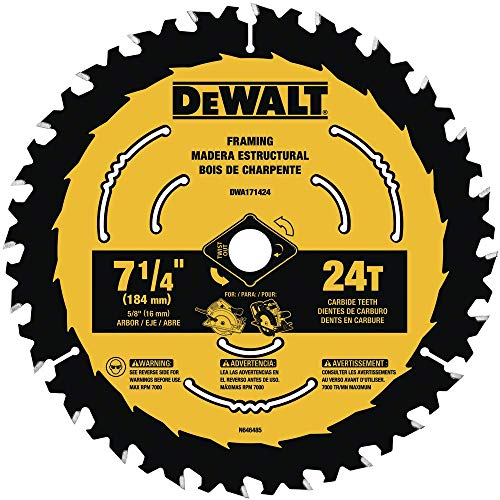 Best for general 7-1/4" dimensional lumberDEWALT 7-1/4 in. 24T Circular Saw Blade (DWA171424)View on Amazon
Our Top Picks
Quick Comparison
| Product | Best for | Key feature |
|---|---|---|
| DEWALT DWA171424 7-1/4″ 24T | General dimensional lumber | Standard wood cutting |
| Revvstark 6-1/2″ 24T&60T | 6-1/2″ saws, mixed cuts | Two-blade pack |
| DEWALT DWA271424 7-1/4″ 24T | Smooth rip and crosscut | Superior tracking |
| Revvstark 5-1/2″ 24T&48T | Compact saws | Heavy-duty TCT teeth |
| Diablo D0724A 10-Pack | Framing volume | Non-stick coating |
| Revvstark 10-Pack 7-1/4″ 24T | Budget multi-pack | ATB tooth grind |
| COMOWARE 7-1/4″ 40T ATB | Plywood and finish cuts | Anti-vibration body |
DEWALT 7-1/4 in. 24T Circular Saw Blade (DWA171424)
DEWALT Circular Saw Blade, 7 1/4 Inch, 24 Tooth, Wood Cutting (DWA171424)
Best for: General wood cutting with a standard 7-1/4″ saw
A straightforward choice for owners who want a familiar brand and a 24-tooth blade for everyday framing and dimensional lumber.
Pros
- Standard 7-1/4″ diameter fits most worm-drive and sidewinder saws
- Clean, predictable rip and crosscut performance
Cons
- Coarser cut than a 40-tooth blade on plywood
Revvstark Circular Saw Blade 6-1/2″ 24T&60T
Revvstark Circular Saw Blade 6-1/2" 24T&60T for Cutting Wood, 5/8" Arbor | Carbide Tipped Teeth, TCT Saw Blades for Cutting Wood, Plastic and Composite Materials, Fit Dewalt Craftsman Ryobi Milwaukee
Best for: Owners of 6-1/2″ saws who want both rip and fine-cut options
Suits anyone running a 6-1/2″ saw who wants a 24-tooth rip blade and a 60-tooth fine-cut blade in one package.
Pros
- Two tooth counts cover rough and finish work
- 5/8″ arbor fits common saw models
Cons
- Only useful if your saw takes a 6-1/2″ blade
DEWALT 7-1/4 in. 24T Circular Saw Blade (DWA271424)
DEWALT 7-1/4 in. 24T Circular Saw Blade, Smooth Cutting, Superior Tracking and Durability (DWA271424)
Best for: Smooth rip and crosscut work on solid lumber
Fits users who want a cleaner edge from a 24-tooth blade on softwood and construction lumber without stepping up to a fine-tooth blade.
Pros
- Manufacturer emphasizes smooth cutting and tracking
- Well-known brand with easy replacement
Cons
- Not designed for high-volume production framing
Revvstark Circular Saw Blade 5-1/2″ 24T&48T
Revvstark 5-1/2"(10mm Arbor) Circular Saw Blade 24T&48T for Cutting Wood | Carbide Tipped Teeth, Heavy Duty TCT Saw Blades for Cutting Various Wood, Plastic and Composite Materials
Best for: Compact saws and lighter-duty wood cutting
A good match for owners of 5-1/2″ saws who need both a rip blade and a 48-tooth option for cleaner crosscuts.
Pros
- Carbide-tipped teeth for longer edge life than basic steel blades
- Covers rip and finish cuts in one set
Cons
- Limited to saws that accept a 5-1/2″ blade
Diablo Framing Saw Blade 7-1/4″ x 24T, 10-Pack (D0724A)
Diablo Framing Saw Blade – 7-1/4" x 24-Tooth, 8000 Max RPM, 10-Pack | Ideal for Wood – TiCo+ Hi-Density Carbide, Perma-SHIELD Non-stick Coating, Tri-metal Shock Resistant – D0724A
Best for: Framing crews and anyone cutting through large volumes of lumber
Ideal for jobs that burn through blades quickly, where buying a 10-pack keeps a spare on hand at all times.
Pros
- Ten blades in one pack for high-volume framing
- Non-stick coating reduces resin buildup on pine and fir
Cons
- Overkill for occasional DIY use
Buying Guide
Blade Diameter and Arbor Size
The blade diameter must match what your saw is designed to take, and the arbor (the center hole) must fit the saw’s spindle. Most handheld circular saws use a 7-1/4 inch blade with a 5/8 inch arbor, while smaller saws often use 6-1/2 or 5-1/2 inch blades with a 10mm arbor. Check your saw’s manual or the label on the blade guard before you buy.
Tooth Count
Fewer teeth remove material quickly and suit rough framing and fast crosscuts. Higher tooth counts leave a smoother edge and work better for plywood, laminates and finish trim. A 24-tooth blade is a good all-around choice for general wood work, while 40 to 60 teeth are better when the cut quality matters more than speed.
Tooth Geometry
Alternate top bevel (ATB) teeth give clean cuts across grain and are common in finish-oriented blades. Combination blades mix tooth shapes to handle both ripping and crosscutting. Framing blades use simpler geometry for speed, so they are better for rough lumber than for delicate work.
Carbide Quality and Coatings
Carbide-tipped teeth stay sharp far longer than steel and handle abrasive materials like engineered wood. Some blades add non-stick coatings that reduce pitch and resin buildup, which helps the blade run cooler and cut more smoothly over time. Anti-vibration bodies can also make the saw easier to control and improve cut quality.
FAQ
Can I use a wood blade to cut plastic or composite materials?
Some carbide-tipped wood blades are rated for plastic, PVC and composite decking, but the tooth geometry and speed still matter. Check the blade’s listed materials before using it on anything other than wood. Cutting slowly and keeping the blade clean helps prevent melting and binding.
How many teeth should I choose for plywood?
Higher tooth counts, typically 40 or more, produce cleaner edges on plywood and reduce chipping on the top veneer. A lower tooth count will cut faster but may leave a rougher finish. For sheet goods where appearance matters, a higher tooth count is usually the better pick.
Does a bigger blade always cut deeper?
A larger diameter blade generally cuts deeper, but the maximum depth also depends on your saw’s design and adjustment range. Always confirm that the blade diameter is compatible with your saw before installing it. Never exceed the rated maximum blade size for your tool.
How do I know when a blade needs replacing?
Signs include burn marks on the wood, more force needed to push the saw, rough or splintered cuts, and visible chipped or dull teeth. A blade that wanders or binds during cuts may also be worn or damaged. Replacing a dull blade improves safety and cut quality.
Are multi-packs a good value for regular users?
Multi-packs can be a budget-friendly choice for people who go through blades often or work on many projects at once. They also let you keep a spare on hand so a job isn’t delayed by a dull blade. Just be sure all the blades in the pack match your saw’s diameter and arbor.
Conclusion
For general framing and everyday wood work, the DEWALT blades are a reliable starting point, while the Diablo framing blade suits anyone who needs a stack of blades for rough cutting. If you want cleaner finish cuts on plywood, laminates or trim, a higher tooth count like the COMOWARE 40-tooth ATB blade is the better match.
Revvstark blades cover a range of diameters and tooth counts, making them a good fit for smaller saws or mixed materials. Match the blade size and arbor to your saw first, then choose the tooth count based on whether speed or smoothness matters more for your projects.
Related reading
- Saw Blades: Tooth Count, Kerf and Grind for Circular, Miter and Table Saws
- Ryobi Circular Saw Blade Installation: A Step-by-Step Guide
- Oscillating Wood Cutting Tool vs Circular Saw (2026): Which Is Better for Wood?
About Caleb Morgan
Caleb Morgan is part of our editorial team and reviews and edits our power tools guides, checking product details against manufacturer specifications and owner feedback.