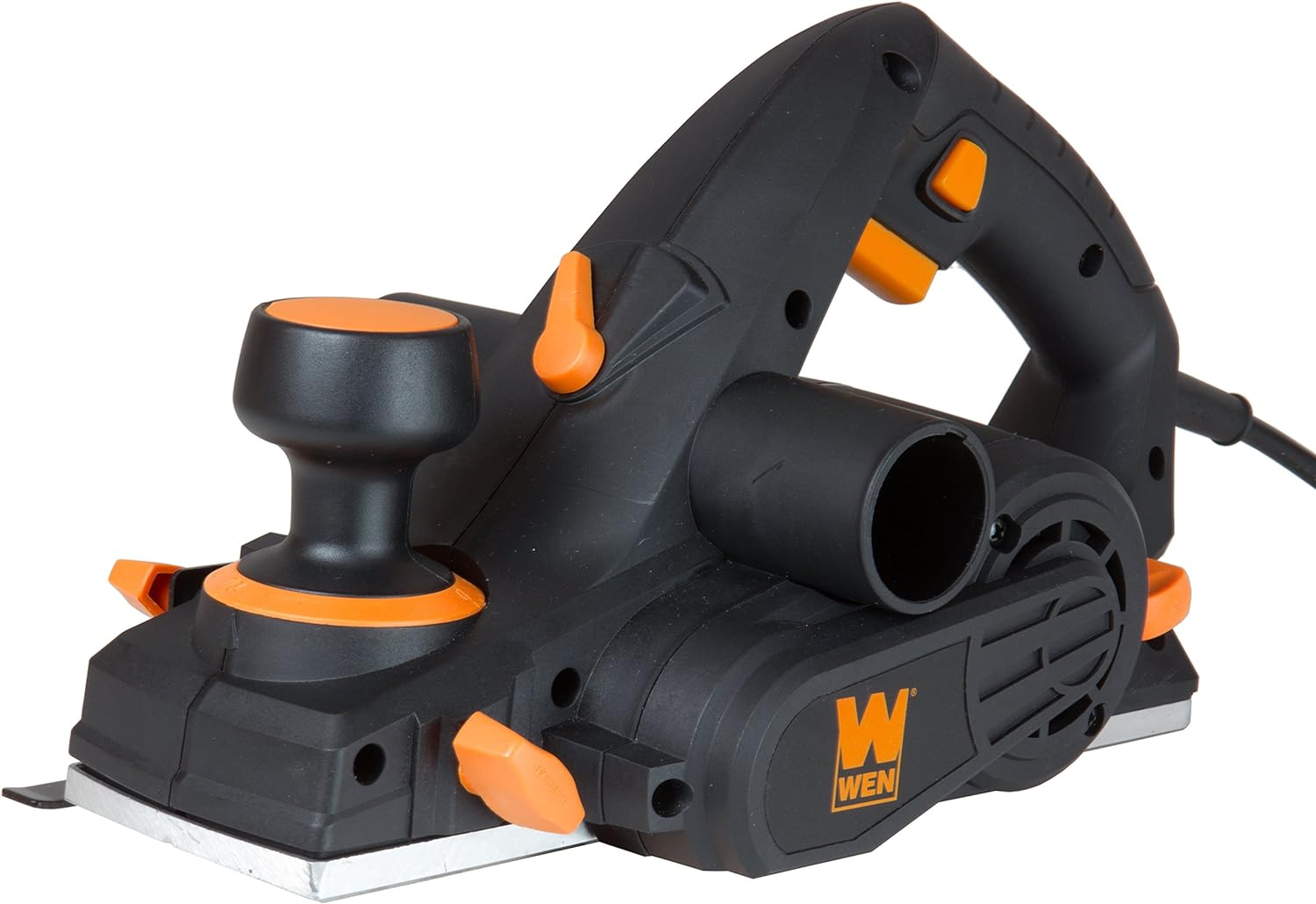
Thickness planers and handheld electric planers are essential tools for smoothing and dimensioning lumber. A thickness planer removes material from the face of a board to create a uniform thickness from end to end, while a handheld planer trims and smooths edges or surfaces for doors, framing, and trim work. This guide explains the key features you need to know, including width capacity, snipe control, blade types, and dust collection requirements, along with critical safety practices.
What a Thickness Planer Does and What It Cannot Do
A benchtop thickness planer takes a rough or uneven board and mills the top face parallel to the bottom face, producing a consistent thickness across the length. It does not flatten a twisted or warped board on its own. If you feed a cupped or twisted board into the planer, the rollers press the board flat as it passes, and the cutters remove material from that compressed shape. When the board exits, it springs back to its original warp, only thinner. To flatten a twisted board, you need a jointer to create a flat reference face, or you must use a planer sled — a flat base that supports the board while you shim it level — before sending it through the planer.
Main Types of Planers and How They Differ
Benchtop Thickness Planers
Benchtop models are the most common choice for home workshops and DIYers. They sit on a stand or workbench, are relatively compact, and can handle boards up to a typical residential width — enough for most furniture and shelving projects. These planers use two or four feed rollers to pull the board through, and the cutterhead removes material from the top.
Stationary Floor-Standing Planers
Larger stationary planers are designed for dedicated shops with higher volume. They have bigger motors, wider capacity (handling very wide boards), and heavier construction that reduces vibration. They cost significantly more and require a permanent space.
Handheld Electric Planers
Handheld electric planers are not for thicknessing boards. They are used for trimming door edges, beveling, fitting framing lumber, and removing small amounts of material from a surface or edge. They have a rotating cutterhead in a shoe that you guide manually. These are useful for adjusting a door to fit an opening or for planing down high spots on studs. Because you control the depth and motion, they allow fine adjustments on installed pieces.
Width Capacity: What Matters for Your Projects
The width capacity of a thickness planer is the maximum board width it can accept. Most benchtop models can handle boards wide enough for common lumber such as dimensional pine or hardwood planks used in tabletops. If you plan to work with wide panels or glued-up slabs, you need a planer with a larger throat. Look at the manufacturer’s spec sheet and compare it to the typical width of the boards you use. A planer that is too narrow will force you to rip boards or skip projects, while one that is unnecessarily wide adds cost and bulk.
Understanding and Reducing Snipe
Snipe is a deeper cut at the beginning or end of a board caused by the board tilting as it enters or exits the planer. The infeed and outfeed rollers lose contact momentarily, allowing the cutterhead to remove extra material. This leaves a slight dip on the last few inches of the board. Snipe is common, but you can minimize it.
Use Infeed and Outfeed Support
Support the board before it enters and after it exits the planer. Adjustable roller stands or a flat extension table keep the board level with the planer bed. This prevents the board from tipping and reduces the chance of snipe.
Feed Boards End to End
When planing multiple boards, butt the trailing end of one board against the leading end of the next. This keeps the rollers engaged continuously, preventing the board from tilting at the tail end. It also saves time by eliminating short snipe on each board.
Adjust Your Technique
Lift the trailing end of the board slightly as it exits to keep it flat against the bed. Some planers have a built-in anti-snipe feature that lifts the cutterhead momentarily. Check your manual for any available adjustments.
Blade Types: Straight Knives vs. Helical Cutterheads
The cutterhead holds the blades that actually cut the wood. The two main types are straight knife cutterheads and helical (or spiral) cutterheads.
Straight Knives
Straight knives are long, straight blades mounted in the cutterhead. They are less expensive to replace and are standard on most budget and mid-range planers. The downside is that they create more noise, can leave a rougher finish on some woods (especially figured grain or knotty lumber), and require all knives to be sharpened or replaced at once. They also produce larger chips.
Helical Cutterheads
Helical cutterheads use many small, square or indexable carbide inserts arranged in a spiral pattern. Each insert takes a small, shearing cut. This results in a smoother surface, less tear-out on tricky grain, and much quieter operation. When an insert dulls or chips, you can rotate it to a fresh edge or replace just that insert. The initial cost is higher, but many woodworkers find the upgrade worthwhile for the finish quality and reduced noise. For heavy production or working with exotic hardwoods, a helical head is a strong advantage.
Dust Collection Needs for Thickness Planers
A thickness planer produces a large volume of chips — far more than a saw or router. The chips are ejected from the top of the machine at high speed. Without proper dust collection, chips can clog the cutterhead, slow feed rate, and create a mess. You should connect the planer to a shop vacuum or a dedicated dust collector with a large-diameter hose (at least 2-1/2 inches or larger). Many planers have a chip ejection port designed for a standard dust hose. If the chips are not evacuated well, they can also cause the planer to jam. Always check your manual for the recommended dust collection method. For handheld electric planers, dust collection is typically less critical, but a bag or a shop vac connection helps keep the work area clean.
Handheld Electric Planers: Doors, Framing, and Trim
A handheld electric planer is not a replacement for a thickness planer. It is designed for surface and edge work on installed or freehand pieces. Common uses include:
- Trimming a door that sticks against the frame
- Beveling or chamfering edges
- Flattening high spots on studs or joists
- Removing old paint or glue from lumber
- Shaping wood for joinery
These planers have a depth adjustment that lets you set how much material comes off in each pass. They are noisy and produce fine chips, so hearing protection and eye protection are essential. Many models have a rebating (rabbeting) guide for cutting steps or grooves along the edge of a board. For fine adjustments, a block plane or hand plane is often quieter and more precise.
Safety Essentials for Thickness Planers and Hand Planers
Power tools can cause serious injury. Always follow these safety rules:
- Read and follow the tool manual for all setup, operation, and maintenance instructions.
- Wear eye protection, hearing protection, and a dust mask. Thickness planers are loud and produce fine dust.
- Never plane boards shorter than the minimum length specified in your manual. Short boards can kick back or be pulled in dangerously.
- Inspect every board for nails, screws, staples, or other metal before planing. A single nail can ruin blades and cause shrapnel.
- Keep guards in place. Do not remove or bypass safety features.
- Unplug the planer or remove the battery before changing blades or clearing jams.
- Ensure the planer is on a stable surface and the workpiece is supported to prevent tipping.
Common Buying Mistakes
A common mistake is buying a planer with too small a width capacity for your typical projects. Another is overlooking the cost and effort of blade replacement — straight knives are cheaper but require more frequent sharpening or replacement. Some buyers also underestimate the noise level and dust volume, failing to budget for hearing protection and a proper dust collector. For handheld planers, buying a model without adjustable depth stops or with poor ergonomics can make fine work difficult.
Care, Cleaning, and Upkeep
Keep the planer bed and rollers clean. Pitch and resin buildup can cause boards to stick or feed unevenly. Clean the bed with a solvent recommended by the manufacturer. Wipe down the feed rollers with a rubber-safe cleaner to maintain grip. Check blades regularly for dullness or nicks; replace or rotate inserts as needed. Lubricate moving parts according to the manual. Store the planer in a dry area to prevent rust on the bed and cutterhead.
FAQ
Can a thickness planer make a twisted board flat?
No. A thickness planer only makes the top face parallel to the bottom face. If the board is twisted or cupped, you must first create a flat reference face using a jointer or a planer sled with shims.
What causes snipe and how do I prevent it?
Snipe is caused by the board tilting as it enters or exits the planer, letting the cutters remove extra material. Reduce it by using infeed and outfeed supports, feeding boards end to end, and lifting the trailing end of the board as it exits.
Should I upgrade to a helical cutterhead?
If you work with figured woods, want a smoother finish, and prefer quieter operation, a helical cutterhead is worth the higher cost. For general use with straight-grained lumber, straight knives work well and are cheaper to replace.
Do I need a dust collector for a thickness planer?
Yes. Thickness planers produce a large volume of chips that can clog the machine and create a mess. A shop vacuum or dust collector with a large-diameter hose is recommended to keep the planer running efficiently.
Final Thoughts
Choosing the right planer depends on the size of your projects, the types of wood you work with, and your tolerance for noise and dust. Benchtop thickness planers are a solid choice for most home shops, and understanding how to reduce snipe and select blades will improve your results. A handheld electric planer is a handy complement for doors and framing. For more on planers and other woodworking tools, explore our guides on planers and woodworking tools.